


We spend thousands of dollars on our horses: custom saddles, chiropractic work, massage therapy, proper shoeing and regular dental care. We take the time to think about matching the color of our saddle blanket to our show clothes, but how many of us think about what’s going on between our horse’s back and the saddle?
That cheap saddle pad on your horse’s back may cushion your horse from the saddle, but it likely doesn't have any support or minimal support, especially as the pad ages.
So how can you be sure you're making the right choice when it comes to your saddle pad?
Thickness
Saddle pads come in a variety of thicknesses, from as thin as ¼ inch to as thick as 1 ½ inches. While some may feel that the thicker the pad, the better the protection, that’s not the case for most horses. One size does not fit all when it comes to saddle pads and horses. Pad thickness can affect how your saddle sits on your horse and how you ride.
If you are a Western competitor or prefer to ride with a woven saddle blanket over the top of a pad, be aware of the thickness that the blanket adds and how adding the two can affect saddle fit. Typically, competitors will use a half-inch saddle pad with a woven blanket to keep a more streamlined fit.
Pad Shape
It’s important to consider your riding discipline when selecting a saddle pad. Different events call for different saddles, as well as saddle pads. For example, horses that compete in barrel racing tend to require a smaller, rounded cut to their pad to match the barrel saddle which has a smaller skirt. This shape allows the body to bend without interference, for better and tighter turns. On the other hand, the Western Pleasure saddle has a rather large skirt, so most Western all-around riders use large, square pads.
Saddle pad shapes can also differ depending on the construction and shape of the spine. One popular shape is the contoured pad, designed to be a closer fit to the spine, which can be a good fit for horses with a slight swayback. Straight/square pads are the average and can be used on horses with normal conformation as well as those with round withers. Round saddle pads can be used on horses with short backs or under saddles with rounded skirts.

If you're looking for a square saddle pad with a closer feel to your horse, a close contact saddle pad features a cutout that allows your leg to hang closer to your horse for a more custom-like seat.
Horses with high withers might need more clearance. A cutout pad is popular for this because the opening can relieve the pressure on the horse’s withers. There are also cutback-style saddle pads that feature a cut at the top front of the pad to also eliminate pressure points on the withers. Both the cutout and cutback pads will have a contoured spine to allow for a close and correct saddle fit.
Material
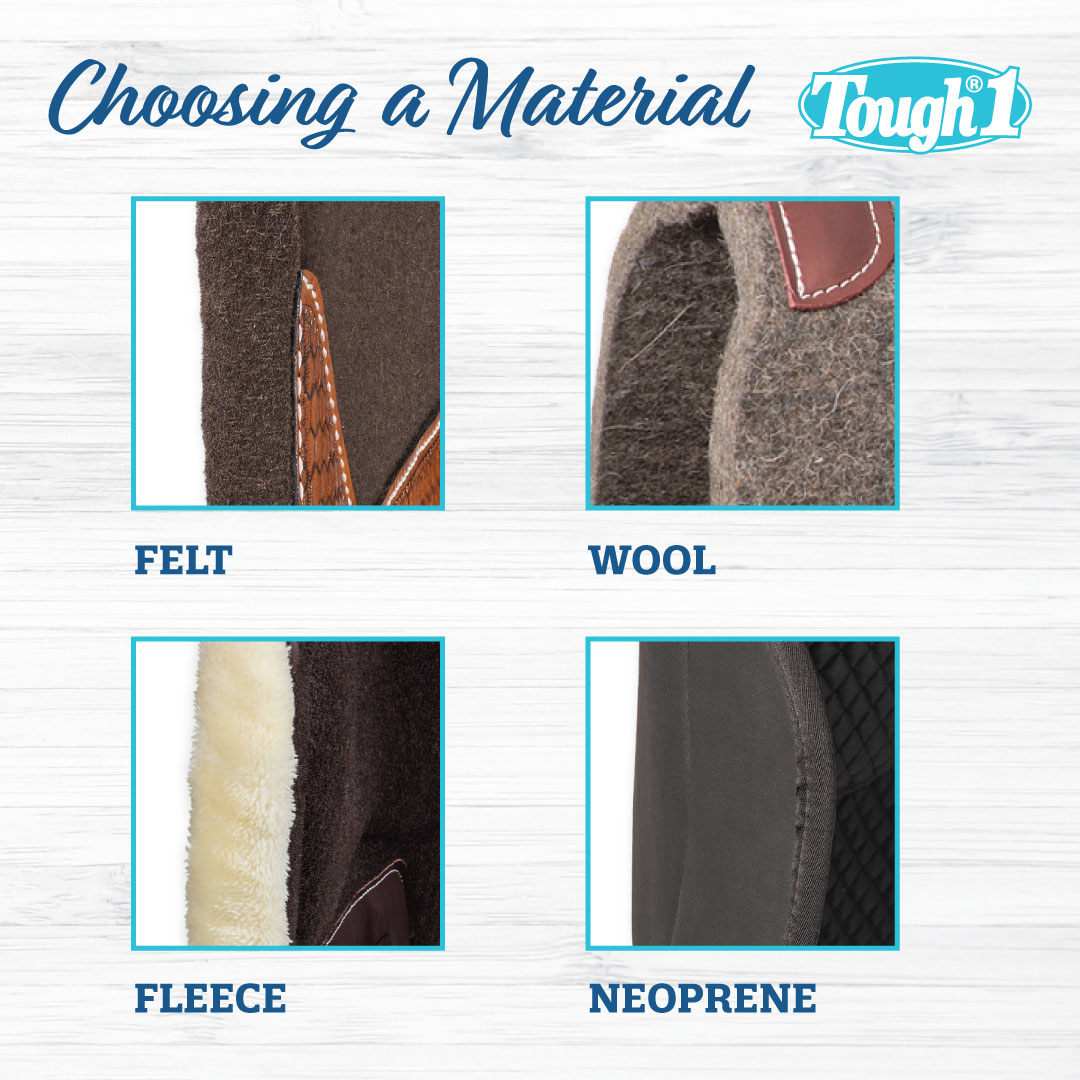
When you squeeze that fluffy, squishy pad and think that it would feel great on your horse’s back, that’s not necessarily the case. A soft material might be too soft to provide adequate support.
Fleece While some of the most common pads are made with fleece bottoms (synthetic or genuine), that isn’t the only choice these days. Fleece pads may feel great, but they get dirty and matted much easier than other materials.
Compressed Wool Felt Compressed wool felt can wick sweat away from a horse’s body and is great for shock absorption.
Neoprene A popular choice is a felt or wool saddle pad with a neoprene bottom. The waterproof, rubber texture, provides a nice cushion that is also easy to clean.
You might think that you want a pad that doesn’t move on the horse’s back. That statement is not healthy. If a saddle pad isn’t moving with your horse to some degree, then it’s rubbing him every step of the way. You might like it, as a rider, because it holds you more stable, but your horse may not be comfortable.
Speaking of sweat, experts give insight into what a proper sweat pattern should look like on a saddle pad: Ideally, the horse’s back should be wet on both sides with a dry strip down the spine. Depending on the height of the horse’s withers, the pad might be drier toward the front of the pad due to increased airflow. Keep in mind that your horse may not have an ideal sweat pattern due to other factors such as conformation, health or saddle fit.
Frequency of Use and Replacement
When was the last time you replaced your saddle pad? If you’re not already aware of how crucial a saddle pad is to your horse’s performance, health, and overall well-being, it might have been a while. Consider a runner. A general rule of thumb is that runners should replace their shoes between 300-500 miles. Why? The treads wear out, the fabric stretches, and they lose their support, shock absorption and cushioning features over time. The same thing happens with saddle pads.
Although it can be a significant overhead cost for trainers and exhibitors who ride their horses daily and compete in all-around events, it's essential to inspect your pad after every ride to ensure it's not causing any rubbing or discomfort. If it’s been several years since you purchased your pad, you might want to consider replacing it. That extra cost in replacing your saddle pad more frequently can end up saving you a lot of money in the end from veterinarian fees and lost efforts in the show pen.
Here are a few signs it's time to replace your pad:
- When the pad is caked in dirt, sweat and hair. (How to clean a saddle pad coming soon!)
- Your wear leathers for the billet straps start to get sunken to the point where you have minimal material between the latigo and your horse’s side.
- You notice more movement of the saddle than normal.
Furthermore, just because a pad fits your horse’s back in 2022 doesn't mean that the pad itself, or even the cut and thickness, is still as effective today. As with humans, horses' bodies are constantly fluctuating in terms of weight, muscle tone and overall conformation. You might consider using a shim pad, which allows you to be more flexible with your saddle pad amongst different horses.
Take Home Message
There’s so much to think about when it comes to outfitting your horse with the best fitting and most effective tack and equipment for your budget. Keep in mind that the fit of your saddle is, first and foremost, the number one priority, with the saddle pad fit being a close second. Giving a little more consideration to an otherwise small part of your budget can mean bigger returns in your horse’s performance and future.


